
|
GMap is an algorithm for visualizing graphs as
maps; the GMap visualization system is fully functional online. Information visualization can be invaluable in making sense out of
large data sets. However, traditional graph visualization methods often fail
to capture the underlying structural information, clustering, and
neighborhoods. GMap, provides a way to overcome some of the shortcomings with the help of the geographic map metaphor. While graphs, charts, and tables often require considerable effort to comprehend, a map representation is more
intuitive, as most people are very familiar with maps and even enjoy
carefully examining maps. The effectiveness of GMap is illustrated with
examples from several domains, namely TV shows, Amazon books, and
last.fm music. The last map led to over 630K views on a stumbleuppon.
|

|
Lombardi is a new force-directed spring embedder for graph drawing, inspired by the style of the American artist Mark Lombardi. The main features that set our Lombardi spring embedder apart from other approaches are that straight edges are replaced by circular arcs, and that the arcs around each vertex are evenly spaced out. The objectives of this approach are to improve readability and aesthetic appeal of graph drawings. Initial user feedback strongly indicates the aesthetic appeal of this style of drawing, with some associated keywords being “more natural”, “balloon animals”, “blobby”, “cute and cuddly." A picture gallery and movie gallery illustrates the approach.
|

|
Semantic Word Clouds: A
word cloud consists of the most important
words in a text document. In a
semantic-preserving word cloud, related words
are placed close to each other. Words are scaled by a factor roughly
proportional to their importance. The clouds can be modified with
various fonts, layouts, and color schemes.
|

|
Maps of Computer Science: The
MOCS project provides a method to visualize concept maps of topics from the DBLP database of computer science research papers. We use the titles of papers in the database to extract prominent words and phrases and calculate their similarity based on cooccurrence in titles. These terms are clustered and laid out based on their similarity values, providing a visual representation of topic space. Heatmap overlays allow us to visualize the profile of a time frame, conference, journal, or author over the base map. Also, different base maps can be created: maps that are representative samples of all papers available in DBLP, or maps limited to specific time frames, conferences, journals, or authors.
MOCS makes topic maps of the field, heatmaps of various conferences (e.g., STOC), journals over time (e.g., JACM first decade vs last decade), as well as researchers and groups.
|

|
Citizen Scientists for Trajectory Analysis: We study the use of games and crowd sourcing to capture and analyze scientific trajectory data. We design games to employ citizen scientists to trace (i) static objects in images and (ii) moving objects such as ants or bees in video data. We study the challenging data validation problem of selecting for each object, one accurate trajectory from the several (possibly inaccurate) trajectories which are submitted by the citizen scientists playing our game. For numerical values finding the consensus of several estimates is easily done by taking an average . Computing the consensus of traces is not as straight forward. We design algorithm which use clustering, geometric alignment, sampling, as well as other methods for this purpose.
|

|
Algorithms for Cartogram Computations: Cartograms are used for visualizing geographically distributed data by scaling the regions of a map (e.g., countries in Europe) such that their areas are proportional to the data associated with them (e.g., GDP). Thus the cartogram computation problem can be thought of as a map deformation problem where the input is a planar polygonal map and an assignment of some positive weight for each region.
The goal is to create a deformed map where the area of each region realizes the weight assigned to it (no cartographic error) while the overall map remains recognizable (e.g., the topology, the relative positions and the shapes of the regions remain the same). Since achieving no cartographic error and preserving map readability are impossible to achieve simultaneously, all the cartogram generation algorithms tolerate some error in one or both of these criteria. We define some quantitative measures that can be used to evaluate how faithfully a cartogram represents the weights, as well as several measures for evaluating the readability of the final representation. We then study several early algorithms for computing cartograms and two new ones and compare them in terms of our quantitative measures.
|

|
GraphSET is our Graph Simultaneous Embedding Tool. We developed this software in order to have a pracatical way to study several types of problems in simultaneous graph embeddings: simultaneous geometric embedding, simultaneous embedding with fixed edges, and colored simultaneous embedding. GraphSET can be used to study theoretical problems in simultaneous graph drawing and to produce drawings from known algorithms for these problems. The software and the code are available for download together with a user guide, screenshots, and simultaneous embedding challenges.
|

|
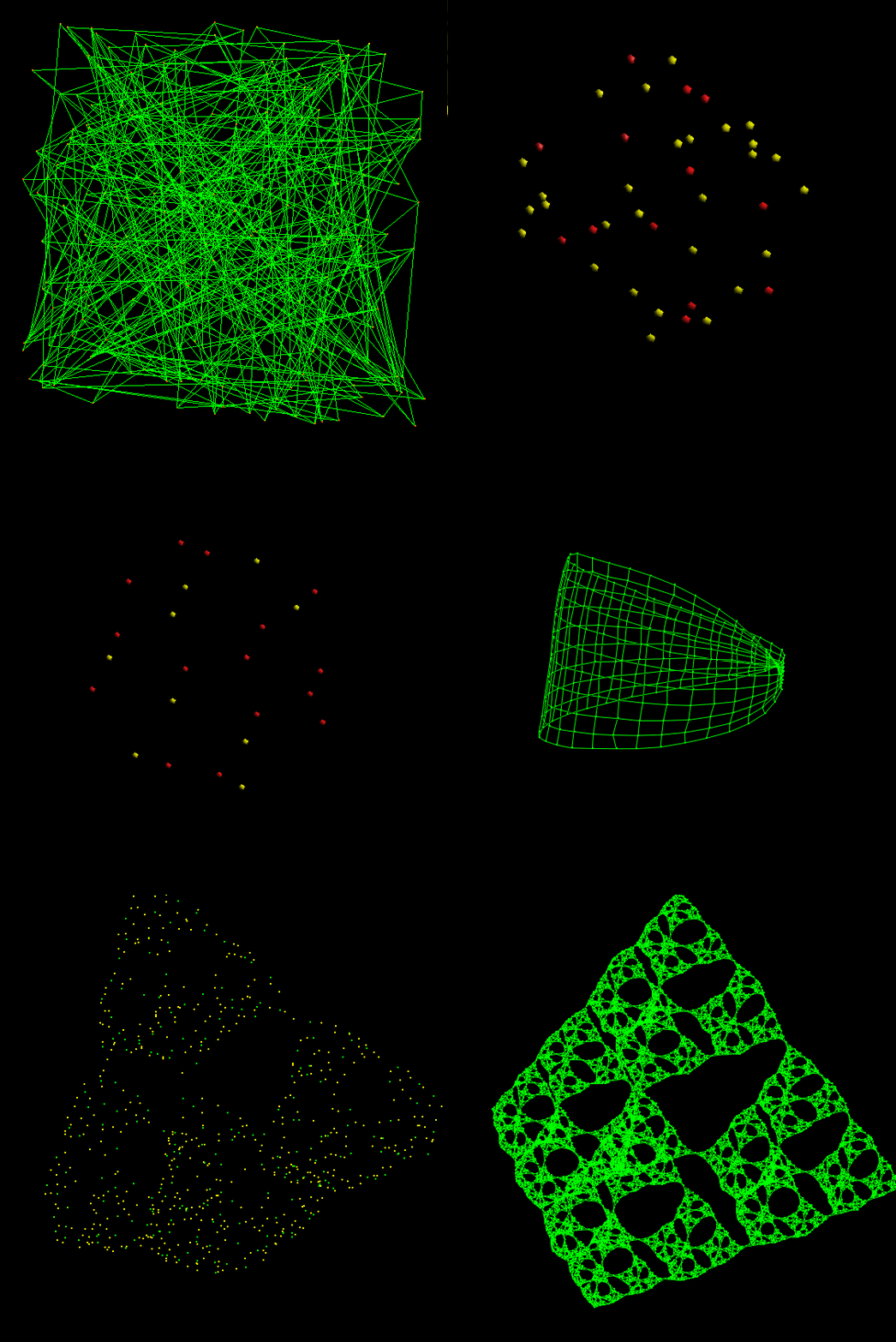
SMorph: Spherical Graph Morphing
SMorph is a project that deals with morphing of graph drawings
on the surface of the sphere. We are interested in the problem
of intersection-planar graph morphing,
and in particular, a generalization from Euclidian space to
spherical space. We show that under certain conditions, there
exists a continuous and intersection-free morph between two sphere
drawings of a maximally planar graph, where sphere drawings are
the spherical equivalent of plane drawings: crossings-free
geodesic-arc drawings. In addition to the existence proof,
we describe a morphing algorithm along with its implementation.
|
 |
GRIP: Graph
Drawing with Intelligent PlacementGRIP is designed for
drawing large graphs and uses a novel multi-dimensional force-directed
method together with fast energy function minimization. The algorithm
underlying the system employs a simple recursive coarsening
scheme. Rather than being placed at random, vertices are placed
intelligently, several at a time, at locations close to their final
positions. The running time and space complexity of the system are
near linear. The implementation is in C using OpenGL for 3D
viewing. GRIP allows for drawing graphs with tens of thousands of
vertices in under one minute on a mid-range PC. To the best of the
authors' knowledge, GRIP surpasses the fastest previous
algorithms. However, speed is not achieved at the expense of quality
as the resulting drawings are quite aesthetically pleasing. For a
sample of what GRIP does, take a look a few animated examples. |
 |
TGRIP: Temporal Graph Drawing
TGRIP is an application
designed for interactive visualization of large weighted graphs that
have a temporal component. TGRIP is designed for drawing large graphs
and uses a novel multi-dimensional force-directed method together with
fast energy function minimization. The algorithm underlying the system
employs a simple recursive coarsening scheme. Rather than being placed
at random, vertices are placed intelligently, several at a time, at
locations close to their final positions. In most applications it is
necessary to be able to visualize graphs in which vertices/edges have
weights. The layout component should take into account these weights
while doing the placement. A pair of vertices connected with a large
weighted edge should be placed closer to each other than another pair
with smaller edge weight for example. TGRIP handles this by
introducing the weight concept to the general force-directed
method. The graphs that we are interested in evolve through time. The
changes in the graph include adding and removing vertices/edges. TGRIP
allows us to control the tradeoff between readable drawings and mental
map preservation between consecutive drawings. Finally, the system
generates smooth animations between consecutive time steps.
|
 |
GraphAEL: Graph Animations with Evolving Layouts
GraphAEL extracts three types of evolving graphs from the Graph
Drawing literature and creates 2D and 3D animations of the evolutions.
We study citation graphs, topic graphs, and collaboration graphs. We
also create different graphs which capture the nature of change
between two given time periods. |
 |
graphael
graphael is a system that implements several classic
force-directed layout methods, as well as several novel layout methods
for non-Euclidean geometries, including hyperbolic and spherical. The
system can handle large graphs, using multi-scale variations of the
force-directed methods. Finally, the system can layout and visualize
graphs that evolve though time, using static views, animation, and
morphing. The current system is equipped with a core package of
force-directed algorithms and visualization tools. In addition to
putting together well-known algorithms and visualization methods,
graphael contains several novel features. Some of these features
include support for temporal graphs, interactive graph visualization,
multi-scale layout algorithms for large graphs, and embedding graphs
in non-Euclidean spaces, such as hyperbolic space and spherical space. |
 |
TetraTetris
TetraTetris is a multi-user game utilizing a DiamondTouch
table. The DiamondTouch table is a touch-sensitive input device that
allows several users to interact with a program at the same time and
do so using their hands. We describe our exploration of the
capabilities and limitations of the DiamondTouch by focusing on
TetraTetris, one of the first nontrivial applications written
specifcally for the DiamondTouch hardware. TetraTetris is a
multi-player game, loosely based on the popular game Tetris, in which
players use their hands to manipulate objects moving around on the
table; it illustrates some of the table's key advantages and drawbacks
by comparison with conventional input hardware. In this paper we
describe the DiamondTouch hardware, the rules of TetraTetris, the
problems we encountered implementing it, and what TetraTetris can show
us about the future of input devices like the table. |
 |
Simultaneous Embedding
Simultaneous Embedding is a new graph theoretical problem.
This project deals with the simultaneous embedding of multiple planar
graphs. The goal is to produce aesthetically pleasing drawings for the
two graphs by means of a heuristic algorithm and with human
assistance. Our implementation uses the DiamondTouch table, a multi-
user, touch-sensitive input device, to take advantage of direct
physical interaction of several users working collaboratively. The
system can be downloaded or the corresponding applet can be used online. |
 |
GMorph: Intersection Free Morphing of Planar Graphs
GMorph is an implementation of an algorithm for morphing of planar
graphs. Morphing refers to the process of transforming one shape (the
source) into another (the target) In planar graph morphing we would
like to transform a given source graph to another pre-specified target
graph. A smooth transformation of one graph into another can be useful
for numerous problems from graph drawing. In particular, when dealing
with dynamic graphs and graphs that change through time, it is crucial
to preserve the mental map of the user. Thus, it is important to
minimize the changes to the drawing and to create a smooth transition
between consecutive drawings. Another important goal is to avoid
creating any intersections throughout the morph. We designed and
implemented an algorithm that can morph between drawings with
straight-line segments, bends and it relies on a combination of
techniques to achieve smooth transformations: rigid morphing,
compatible triangulations, as well as morphing based on interpolation
of the convex representations of the graphs. Here is a short (5 min) but large (200MB+) video overview of
the project. |
 |
SIMG: Simultaneous Graph Drawing
Consider the problem of drawing and displaying a series of related
graphs that share all or parts of the same vertex set. The graphs may
represent different relations between the same set of objects. SIMG
illustrates different approaches to simultaneous graph drawing. We
have developed and implemented three different techniques for laying
out a series of graphs to be simultaneously embedded. We have also
designed and implemented three different schemes for visualizing
multiple graphs. While each of these visualization schemes
corresponds closely to one of our layout algorithms, any combination
of a layout algorithm and a visualization scheme can be used. When
visualizing a series of graphs that share all or parts of the same
vertex set, it is important to display the graphs in such a way that
the user can either focus on one graph at a time without being
confused by the other graphs in the series or visualize the layouts
of multiple graphs at the same time to get a mental map between the
different relations represented by each graph. |
 |
Fat-Edges Graph Drawing
Traditionally, graph drawing algorithms represent vertices as
circles and edges as closed curves connecting the vertices. In this paper we
consider the problem of drawing graphs with edges of variable thickness.
The thickness of an edge is often used as a visualization cue, to indicate
importance, or to convey some additional information. We present a
model for drawing with fat edges and a corresponding polynomial time
algorithm that uses the model. A short movie and paper illustrate the algorithm.
|
 |
SPLaT: Self-Plagiarism Tool
SPLat is a tool for self-plagiarism detection.
The current version of SPlaT functions as a web spider that crawls
through the web sites of fifty Computer Science departments,
downloading research papers to search for instances of self-plagiarism
by Computer Science academics. Instances of self-plagiarism for each
author are reported so that they may be investigated in order to
determine if they are truly fraudulent papers. |